
Tag: AEO
-
Perplexity Blocks Time’s Agent-Only Ads and Puts Publishers’ Trust Scores at Risk
Time built ads only AI agents can see. Perplexity has decided they will not count, calls the practice deceptive, and says publishers who run them risk a hit to their trust score. Its objection is to the ads existing, not to how they are labeled.
-

Zoom Is Spending on Creators to Get Cited by AI Search
Zoom wants to be read as an AI-first work platform rather than a meetings app, and it is buying creator partnerships to get there. Its CMO acknowledges there is no measurable link between creators and AI citations yet. Brands are now picking creators by who the LLMs quote.
-

Bayer’s Predictive Audience Models Are Beating Its DSP Targeting 4x in Small Tests
Bayer is testing models that spot customers before they churn and price bids by individual rather than cohort — four times standard DSP effectiveness, in small tests its media chief calls a scientific experiment. Its AI search playbook runs through medical journals, not media buys.
-

Google Lets Publishers Leave AI Search
Publishers can now keep their pages out of AI Overviews and AI Mode while staying in traditional search results. The catch is arithmetic: AI Overviews claims more than 2.5 billion monthly users, and opting out means giving up every click that flows from them.
-

Japan Airlines Scores Well on Gemini, Poorly on ChatGPT. It’s Buying Ads to Close the Gap.
Japan Airlines has a measurable problem: Gemini talks about it well, ChatGPT barely does, and Reddit — where travelers argue about premium seats — hardly mentions it at all. Its agency turned that into a targeting input, and the airline is buying its first ChatGPT ads in August.
-
Time Is Selling Ads That Only AI Crawlers Can Read
Time is running a second version of its site that only AI crawlers see — and selling ads inside it. Ally Bank’s sponsored copy went to ClaudeBot and PerplexityBot; Google’s search crawler got the page humans get. Nobody has decided yet whether that kind of ad needs a label.
-
Mod Op Built Its Own AI Layer Rather Than License Seats for 500 Employees
Building rather than licensing saved Mod Op an estimated $3 million, a number describing a bill the agency never received. Its Orion platform sits over the major LLM APIs, automating agency workflows and, eventually, client ones. Most of the usage is still internal. No client has asked for a login yet.
-

Hilton’s Playbook for the “Irrational Affinity Business”: Give Up Control
Hilton is giving away 1 billion Hilton Honors points in a social-first sweepstakes fronted by Paris Hilton and Formula One driver Lando Norris, whose McLaren team has been a Hilton partner for more than 20 years. Global CMO Mark Weinstein frames it as a way to “be back in culture and conversation, in a way…
-
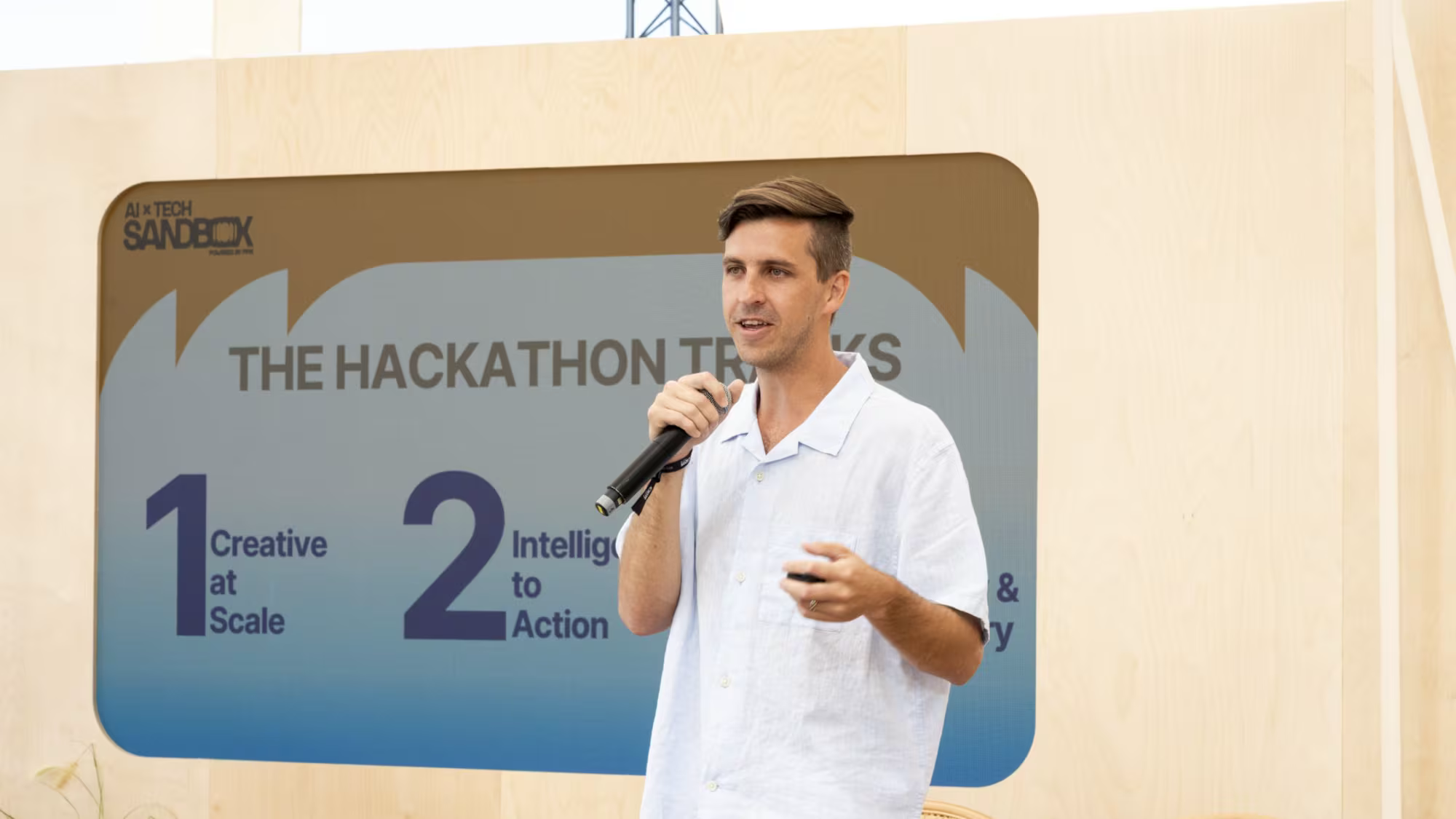
PMG Put $500,000 Behind a Cannes Hackathon and Kept None of the Code
Up to $500,000 in prize money, roughly two dozen entrants, three briefs drawn from real client problems — and PMG keeps none of the code. The agency says the Cannes hackathon demonstrates what AI has done to technical development. It is also a look at who can build.
-

L’Oréal Wants ChatGPT to Stop Learning Skincare From Reddit
L’Oréal has a new OpenAI partnership aimed at two things marketers now pretend are separate: product discovery and content production. The deal plugs OpenAI’s models into L’Oréal’s in-house generative system, CreAItech, and lets the company provide up-to-date product information to the models behind ChatGPT. OpenAI leadership has been keen to say this does not mean…
-

How Unilever is using AI to stay visible in a new era of food discovery
Unilever Foods is treating AI-driven discovery as a parallel universe to the supermarket aisle: one where visibility happens inside voice assistants, AI search tools, and large language models, not just search blue links or endcaps. Olivia Kirby, Unilever Foods’ director of integrated demand generation, says the company is using AI across marketing and product development,…
-

Zoom’s New Marketing Problem: Being Described Correctly by ChatGPT
Zoom CMO Kimberly Storin says a growing part of the job is now “optimizing how [Zoom] appear[s] in conversations with large language models like ChatGPT or Google Gemini.” Depending on who is making the deck, that work goes by answer engine optimization, AEO, generative engine optimization, GEO, or probably several other acronyms currently being laminated.…
-

AI Citations, Demystified: The Robots Have Apparently Discovered SEO
Cyrus Shepard, founder of Zyppy SEO, went spelunking through 54 experiments, patents, and case studies and came back with a ranked list of 23 factors correlated with getting cited by AI search engines like ChatGPT, Gemini, and Perplexity. The headline takeaway is unsexy on purpose: the top factors are URL accessibility, scoring 9.5, and plain…
-
Nearly 80% Of Businesses Struggle To Measure AI Search Impact
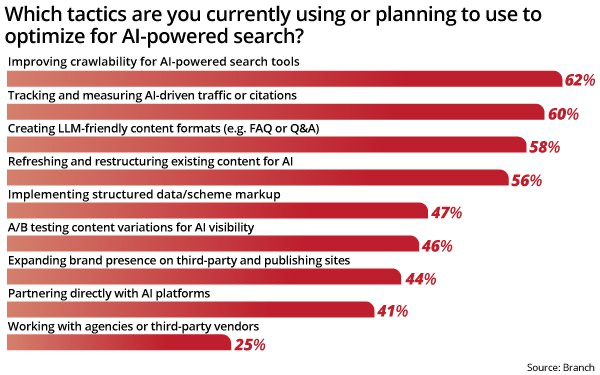
Branch’s new enterprise benchmark data suggests AI-driven discovery is no longer a side quest: 26% of companies say AI search delivered more than half their site traffic in 2025, and 49% expect to cross that threshold by late 2026. AI search’s share of traffic is rising faster than traditional search (up from 35% to 50%),…
-

Inside Pfizer’s plan to bring SEO and AI search in-house
Pfizer has moved its SEO and “AI discoverability” work fully in-house, building the capability in about 60 days, according to a LinkedIn post from its VP of performance media, Joshua Palau. That included new hires, among them Kinesso’s former director of SEO. The reasoning, per Palau: generative AI is reshaping how brands are “discovered, understood…
-
Stagwell Unveils New AI-Powered Search Platform
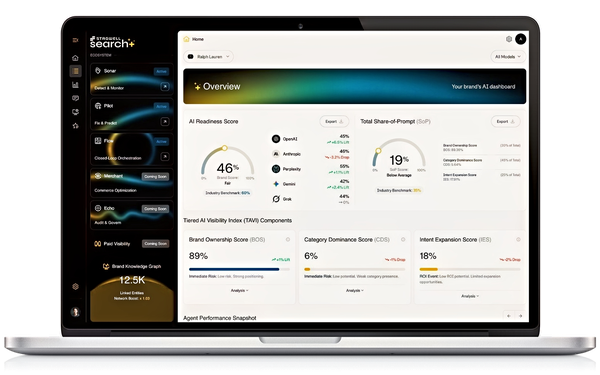
Stagwell has a new entry in the “optimize for the machines that answer instead of the humans that search” category. Called Search+, the platform—built by its Assembly unit with AI visibility company Emberos—is aimed at helping brands show up more favorably inside large language model outputs. The pitch: not just getting clicks, but shaping how…
-

How AI is Shaping Ecommerce for the Holidays
Holiday e-commerce in the U.S. is expected to climb 5.3% this year, and for the first time, retailers are writing AI into their seasonal strategies. Instead of relying solely on Google, consumers are increasingly using ChatGPT and similar platforms to research and compare products. ChatGPT’s own shopping integration, backed by Walmart, Shopify, and Etsy, signals…
-

Why Your SEO Strategy Needs to Embrace AI and GEO
WPP’s chief AI officer Daniel Hulme makes a compelling case: SEO may not be dead, but it’s no longer the sun around which brand visibility orbits. As chatbots and personal AIs take charge of shopping behaviors, traditional keyword-centric strategies are losing relevance. Instead, we’re stepping into the era of Generative Engine Optimization (GEO), where a…
-

The Impact of AI on Consumer Search Behavior
Marketers would do well to pay close attention to shifting consumer search behavior: 87% of U.S. adults now read AI-generated summaries when they search online, and more than 8 in 10 are using AI as part of their shopping decisions. These stats come from the latest Centerfield Gen-AI Consumer Survey, which paints a pretty clear…
-

AI Fatigue: Insights from Consumer Preferences in Search
Gartner’s latest consumer data puts a damper on generative AI’s hype in search. According to a survey of 377 consumers, 61% said they’d prefer the ability to switch off AI-generated summaries in their search results. Skepticism runs deep—53% don’t trust AI’s ability to provide accurate or unbiased information, and 41% say they find AI-generated overviews…
-

Move Over Google—Brands Are Now Courtin’ the Bots
As generative AI tools like ChatGPT and Google’s AI Overviews muscle into search territory, ad agencies are scrambling to make sure brands don’t get buried in digital obscurity. Shops like Jellyfish, Wpromote, and Kepler are spinning up dedicated AI search teams to help clients get a leg up with language models (LLMs), measuring how brands…
-
Examining AI Citation Bias
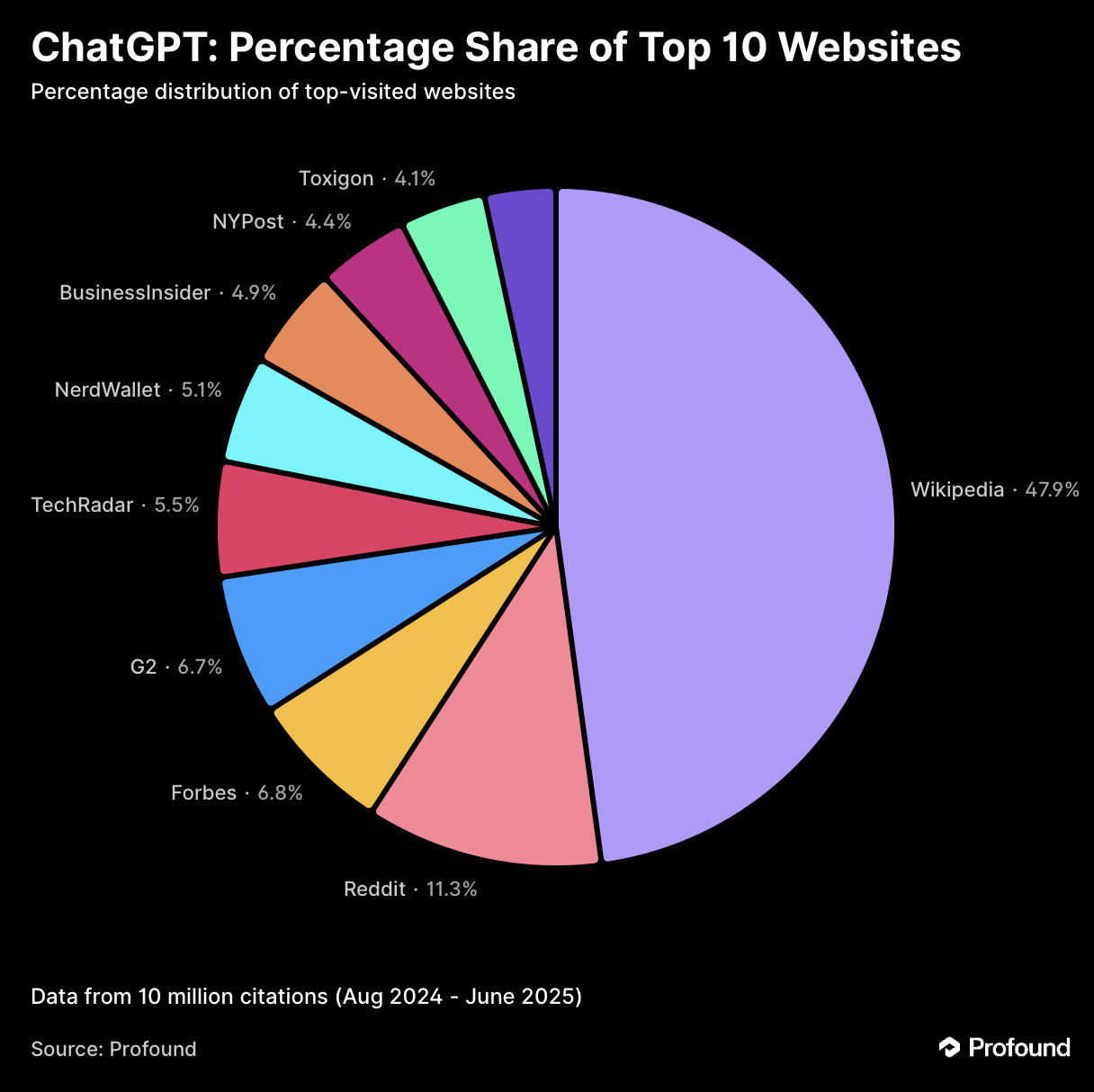
Turns out not all AIs source their answers from the same places. New research from Profound looked at 30 million citations and found that platforms like ChatGPT, Google AI Overviews, and Perplexity play favorites when it comes to where they get their info. ChatGPT’s top source? Wikipedia—by a landslide, clocking in at nearly 48% of…